There is something genuinely psychedelic about pure meaningless noise, what do you think? I assume it is about expanding the moment of not lacking anything, not missing any inexplicable significant “other” (to depend meaning on), the moment that is not determined by something else beyond itself. When everything is given, joy is not defined by what is missing, not limited by it’s opposit. So the research for the beauty of noise might be related to the persuit of limitless joy.
Pure and limitless presence, wouldn’t that just be the end of it all?
On the other hand, aren’t interruptions in the limitless process of signification possible?
In this interview John Cage cites Kant for saying that there are two things that don’t have to mean anything: music and laughter. Then he starts laughing…
…and then he explains a little more what he is talking about. Enjoy!
Well, I am speachless. Check out the artist’s page for better quality versions and even more mind bending animations [the better versions are now embedded here].
When you experience that the actual world you see is only one way of seeing the world, you start perceiving worlds of possibilities amidst the actual. This is a kindred appeal in psychedelic practices, philosophy and modern mathematics etc.
Expand your mind, expand your actual possibilities.
(lots of thanks to Arjan Dhupia again for providing this link)
Sometimes the seeming and the real are not two genuinely different things. Consider the above video: what do we see? Possibly a guy under the influence of drugs. Quite right, however not the way you would expect. He is getting high on sounds. Binaural beats, that is, low-frequent sounds below 1500 Hz that are induced by our brains when both ears are separately stimulated by tones of slightly different frequency (say, 500Hz on the left and 510Hz on the right ear). The resulting phenoma are sounds that you can physically perceive as a beating, modulating tone. Binaural beats are a scientifically proven effect of the human auditory apparatus, and there are people who claim them to be benefitial to relaxation, meditation or anxiety reduction.
What else do we see? We attend an internet hype called “iDosing”, a buzzword for music tracks containing binaural beats of various frequencies. Youtube registers countless videos of teenagers filming themselves getting high on preparated music. These songs, according to online shop i-Doser.com, manipulate your brain waves with intoxicating effects similar to existent drugs like “marijuana, peyote or cocaine”. One track for every trip, just press play.
Which poses a few questions: is the internet our new, completely legal 24h dealer? Do we have to speak of ‘high-loading’ instead of downloading here? Wouldn’t this give a whole new meaning to music compilations? And does it actually work? Judging by the global media coverage that iDosing received, the answer would have to be ‘yes’. But don’t get your hopes up, say music scientists and neurologists. Binaural beats, as EEG tests have shown, can be used to influence our brain wave frequencies to converge to frequency ranges (alpha, theta and delta waves) we predominantly experience during or after sleep. However, there is no scientific evidence of narcotic, or even hallucigenic, effects whatsoever.
So what do we really see here?
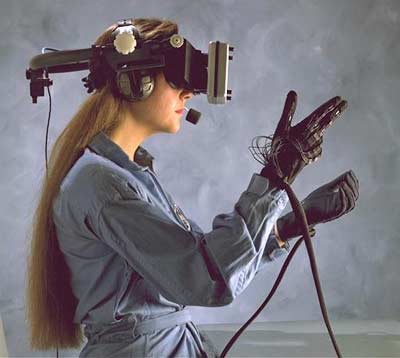
Aside from a collective teenage placebo performance, we see the wonderful distortion of Timothy Leary’s ‘psybernetic’ (psychedelic plus cybernetic) dream. In the late 1970s, future computer technology had been actively linked to narcotics and psychedelia. Promoting virtual reality technology, Leary, among others of the (never contradiction-free) 1960s hippie counterculture, hailed computers as a liberating force. They publicly phrophecised a consensual psychedelic experience, once humans would be able to construct and dive into artificial worlds. Thrilled by the “being in nothingness” of cyberspace, Grateful Dead-songwriter John Perry Barlow noted: “The closest analog to Virtual Reality in my experience is psychedelic”. Science-fiction literature did the rest. Who would have guessed that hippie culture, breathing its last breath, would eventually neglect the body and trade nature for a completely virtual experience?
The media phenomenon called iDosing tells us more about our desires regarding computers and technology than any Apple presentation. It may not be an escapist strategy in the context of cold war politics like Leary’s promotion of cyberspace, but we can see that the computer machine was, and still seems to be, an eschatological getaway of ample quality. Nobody has put this better than Jerry Garcia: technology is the new drugs. iDosing, as a pleasurable media performance, provides yet another vivid example of this interplay between desire, wishes and the computer machine.
That said, did you think we would leave you out in the cold?
“Bullet hell” is a subgenre of “shoot’em up” which is a subgenre of shooter games. Video games don’t come any harder, any more niche or manic. But in the center of the frentic action one of the most beautiful flowers of the gaming world is blooming: bullets are cast at you in ever changing rhythms, ever evolving patterns of lightpulses and color. If you want to survive you got to get into the groove with them.
The THX demo trailer needs not a word to promise us “experience of a different kind”. In a way the psychedelic promise was always present in the way new media and new media technology did connect with our daily lives. It expected us to be longing for “new experience”, “new” in a way you could not have had it before. New technology did kind of guarantee you that it wouldn’t be just more of the “same old”. “New ways of seeing”, “new ways of hearing”! once you had to get lost trying to return home to your wife from a defeated troy, had to keep silent while your friends were eaten by a cyclops and stuff like that before you finally saw things with different eyes. But suddenly in the second half of the 20th century all you had to do was “tune in turn on and drop out.” The subject had changed. Experience had changed, indeed.
Everything is alive! all you ever need is different eyes.
All of these beautiful animations are works of digital media artist Takeshi Murata. I think they express a remarkably pure psychedelic vision and joy in the realm of the digital. Especially the way they develop a sense of space and time and make us look at movement links the digital with the psychedelic.
This is a video of the Dream Machine Brion Gysin and Ian Summerville invented and build after reading William Grey Walter‘s book, The Living Brain. It is a nice diy approach to making mechanical interfaces for psychedelic experiences and experiments widely available.
I hope to write a whole post on mechanical interfaces for conciousness manipulation (compared to chemical interfaces like psychoactive substances) soon.
You can find a java based online version of the dream machine here.





 The Daily Psychedelic Video